
A distal biceps tendon rupture can occur when the tendon connecting the biceps muscle to the forearm tears away from its attachment near the elbow. These injuries often happen suddenly during heavy lifting or when someone attempts to catch or control a heavy object.
While straightforward, acute distal biceps ruptures may be treated by sports medicine physicians and hand or upper-extremity surgeons, complex and chronic distal biceps tears often benefit from specialized hand and upper-extremity surgical expertise.
At the Hand Center of Nevada, Dr. James Vahey treats complex distal biceps tendon injuries, including chronic and retracted tears that can present additional surgical challenges.
Not every distal biceps tear is the same. The time since injury, tendon retraction and scar tissue can all influence treatment options.
A look inside a complex distal biceps procedure
Medical image warning: The photograph below contains exposed anatomy from an actual surgical procedure. Viewing is optional.
View surgical photograph — contains exposed anatomy
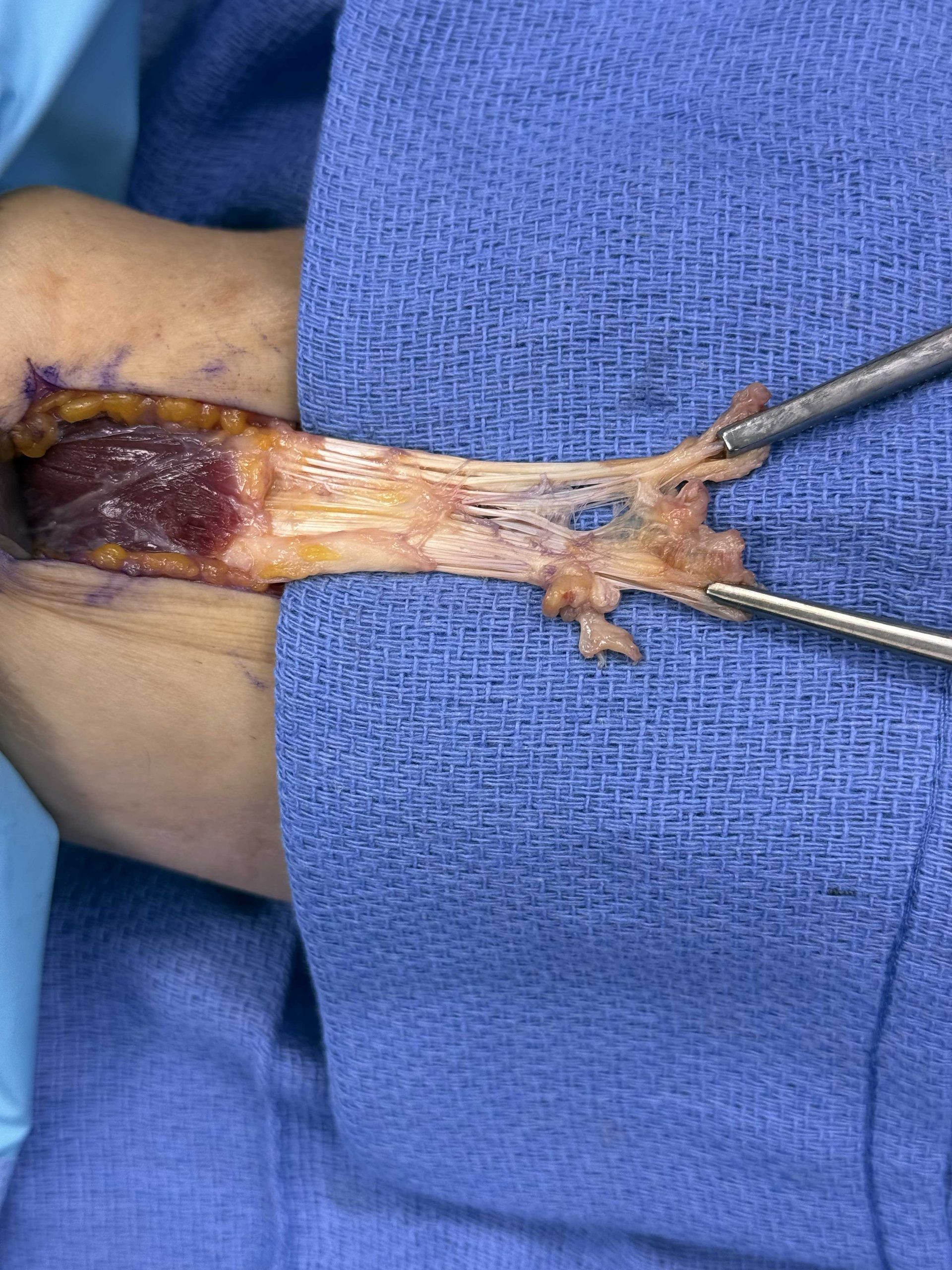
Patient authorization: Surgical images are shared for educational purposes only with appropriate patient authorization.
What makes a distal biceps tear complex?
When a distal biceps rupture is diagnosed and treated relatively soon after the injury, the torn tendon may remain accessible for repair.
As time passes, however, the situation can become more complicated. The tendon may retract farther up the arm, and scar tissue can develop around the injured area. This can make identifying, freeing and mobilizing the tendon more difficult.
Other factors, including the condition of the remaining tendon and the length of time since the original injury, can also influence the surgical approach. This is why an older or significantly retracted distal biceps tear may be very different from a fresh, straightforward rupture.
Why is the distal biceps tendon important?
The distal biceps tendon contributes to bending the elbow, but one of its particularly important functions is helping rotate the forearm into a palm-up position, a movement known as supination.
This motion is involved in many everyday and occupational activities, from turning a screwdriver or doorknob to lifting and carrying objects. A distal biceps rupture can therefore affect strength and function even when a patient can still bend the elbow.
Specialized care for complex and chronic tears
Complex distal biceps injuries require careful evaluation because not every tear is the same and not every patient requires the same surgical approach.
Dr. Vahey completed fellowship training in hand, microsurgery and upper-extremity surgery. His training supports evaluation of injuries involving the interconnected anatomy of the elbow, forearm and upper extremity, including difficult distal biceps tendon injuries.
For patients with a chronic tear, a previously untreated injury, significant tendon retraction or another complicated presentation, an evaluation can help determine what treatment options remain available.
Distal biceps treatment in Las Vegas
If you have experienced a distal biceps injury, or were previously told that an older tear may be difficult to repair, the specialists at the Hand Center of Nevada can evaluate your injury and discuss appropriate treatment options.
Discuss your injury with Dr. Vahey
Schedule a consultation to understand your options for a complex or chronic distal biceps tendon tear.
Individual results and treatment recommendations vary. An examination and appropriate imaging may be necessary to determine the best treatment approach for a particular injury. This article is for general education and does not replace an individual medical evaluation.
Learn more